Crawl space dehumidifier installation: DIY steps, drain options and real costs
How to install a crawl space dehumidifier yourself: seal first, pick the spot, choose pump or gravity drain, and what the unit, parts and power cost.

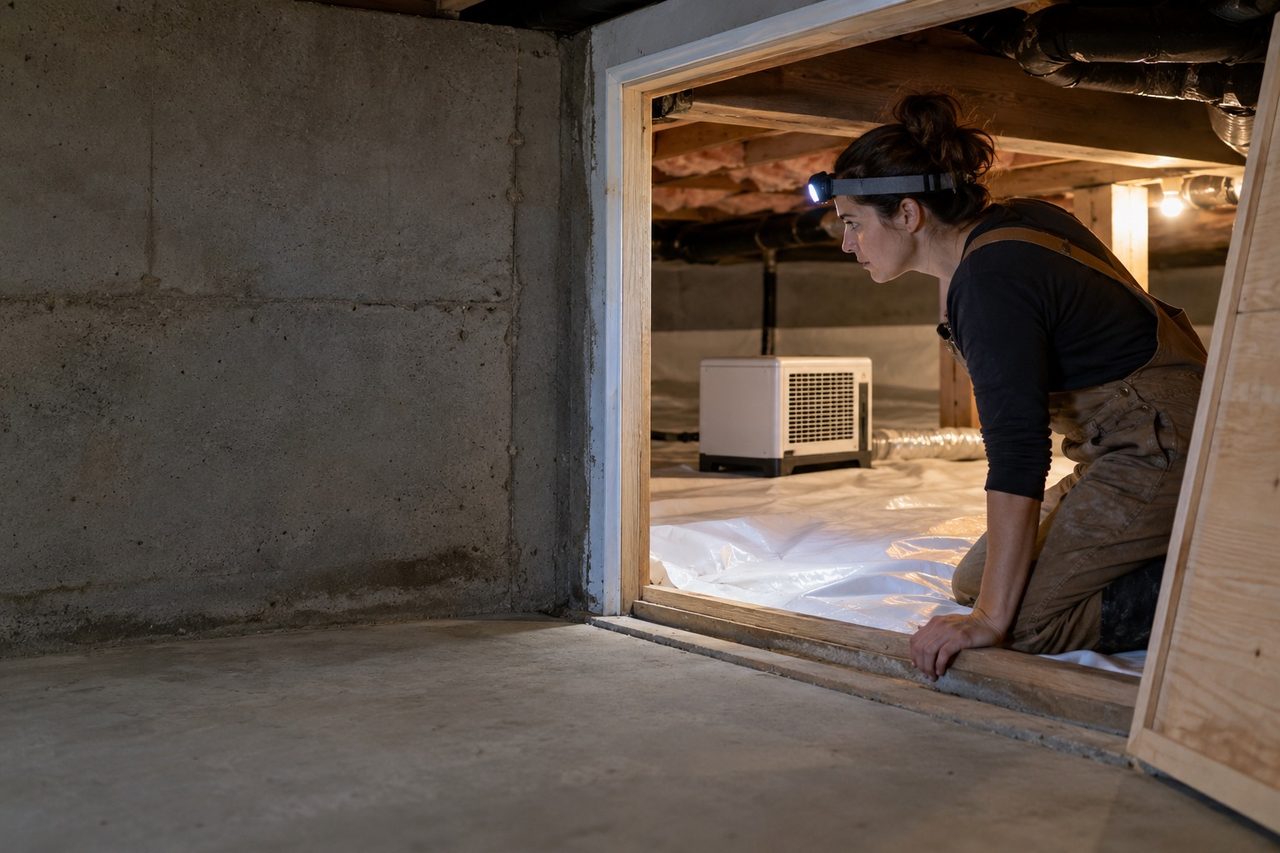
Seal the crawl space first, set the unit level on pavers or hang it from the joists, plug it into a GFCI outlet and send the water to a drain, a sump or outdoors, with a pump when the route climbs. On a DIY job the unit is most of the cost: median $504.83 across the 28 crawl space units we rate (prices on Nov 17, 2026, they may have changed).
Most crawl space installs that disappoint went wrong before the unit was switched on. It went into a vented space with bare dirt, or the hose ended somewhere the water couldn't reach. The install itself is a Saturday job if you're fine on your knees with a headlamp. The prep and the drain route are what need thought, and they're also where the money goes.
Our rankings for this: best crawl space dehumidifiers, best crawl space dehumidifiers with pump, best drain accessories and best dehumidifiers with pump.
Affiliate disclosureAs an Amazon Associate we earn from qualifying purchases made through links on this page. Commissions never change our ratings.
Seal the crawl space before the unit goes in
A dehumidifier dries the air in a closed box. Leave the vents open and the dirt bare, and it spends July drying outdoor air and the ground under your house. So the order is boring but fixed: stop the water that comes in, close the vents, cover the ground with a vapor barrier that runs a little way up the walls, and only then bring the unit down.
Two things to settle first. If water stands on the ground after a storm, that's a grading, gutter or sump problem, and no dehumidifier pump will keep up with it. And if a furnace or a water heater lives down there, ask an HVAC pro before you close anything: some of them pull their combustion air from the crawl space. While you're at it, put a cheap hygrometer in the dampest bay for a week. The EPA's guidance is to keep indoor humidity below 60 %, ideally 30 to 50 % (EPA), and that week of readings is how you'll know later whether the install worked. Our humidity targets guide explains how to read them.
Pick the spot, then check the hatch and the outlet
Measure the access hatch before you order anything. It sounds obvious, and it's still how a Saturday install turns into a Sunday return. Compare the opening with the dimensions in the manual of the exact model. Then pick a spot in the dampest bay or near the middle, with the clearance the manual asks for around the intake and the exhaust, and close enough to the hatch that you can reach the filter.
You can stand it on the barrier or hang it. Twelve of the 32 crawl space units we rate mention a hanging kit or mounting between the floor joists; the Yaufey 216-Pint Commercial with Pump says it can be mounted between joists in a low crawl space. On the floor, set it on two level concrete pavers so it doesn't sink into the plastic. Three of the listings mention ducting, like the Waykar 125-Pint Crawl Space with Pump with its 5.9-inch exhaust vents; that's worth it in an L-shaped crawl space where the damp corner is far from the only good spot.
Power is the part people skip. The unit needs a properly grounded outlet within cord reach (ENERGY STAR), and US electrical codes generally call for GFCI protection on outlets in a crawl space. No outlet down there? That's the electrician's hour of the job. Skip the extension cord unless the manual of your model allows one.
Choose the drain route: built-in pump, add-on pump or gravity
In a crawl space the unit usually sits at the lowest point of the house, so the water has to climb. The drain route decides the install, and often the model.
| Drain route | When it fits | What the catalog shows |
|---|---|---|
| Built-in pump | The water has to climb: over the rim joist, up to the lip of a sump, to a laundry standpipe. | 17 of 32 crawl space units state one; stated lift 16.4 to 19.6 ft. |
| Gravity hose | A drain, a sump or daylight sits lower than the unit's outlet along the whole route. | 15 crawl space units rely on it; 3/4" hoses from 5 to 13 ft, $7.99 to $21.98. |
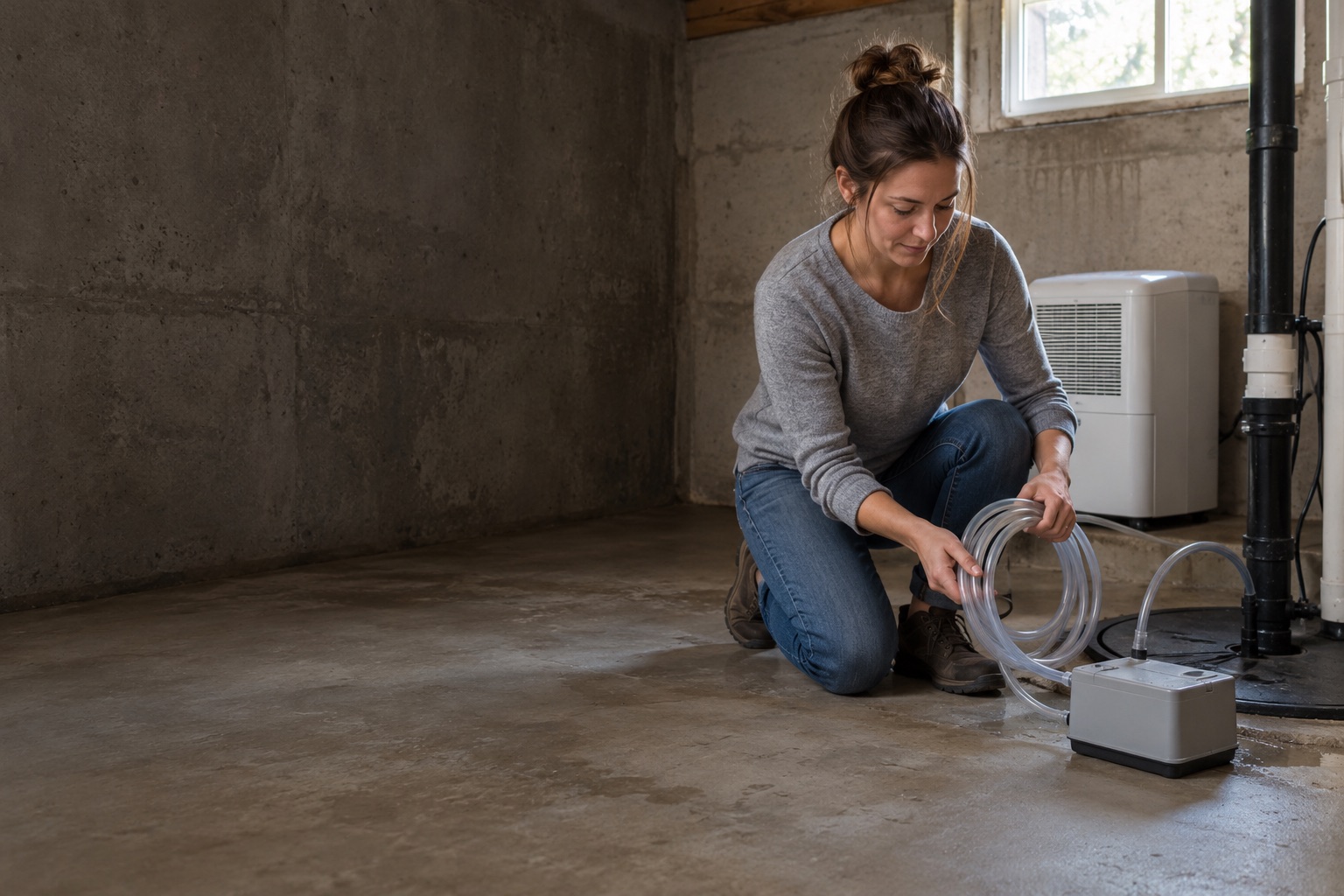
| Add-on condensate pump | You already own a gravity unit, or prefer one, but the water still has to go up. | 5 pumps rated, stated lift 6.6 to 33 ft, $37.99 to $57.99. |
Our pick for a crawl space you visit twice a year is a pump unit that keeps a gravity outlet as a fallback. The Waykar 125-Pint Crawl Space with Pump ships a 16.4 ft pump hose and a 6.6 ft gravity hose, and states 16.4 ft of lift. If the pump clogs, the short hose keeps the space dry until you've cleaned it.
Already own a gravity unit? The ALORAIR Sentinel HD55 has no tank and drains automatically, but it doesn't pump. Put an add-on pump below its outlet: the Aquastrong Condensate Pump, 85 GPH states 85 GPH and 20 ft of lift, and has a high-level safety switch with two lead wires meant to shut the appliance off before the reservoir overflows. Wire that switch: without it, a stuck float means water on the barrier. The gravity drain vs pump guide shows how to measure the climb, and hoses and pumps are ranked in our drain accessories ranking.
Step by step: a DIY crawl space dehumidifier install
With the space sealed and the drain route decided, the install takes an afternoon.
- Read the installation section of the manual first. If it asks you to let the unit stand upright after transport, do it.
- Lay the two pavers on the barrier and level them, or fix the hanging brackets to the joists with the hardware the maker specifies.
- Push the hose onto the outlet, clamp it, and route it. Gravity: a steady fall all the way, no loops, no sag. Pump: straight to the highest point, then down. Clip the hose to the joists every few feet.
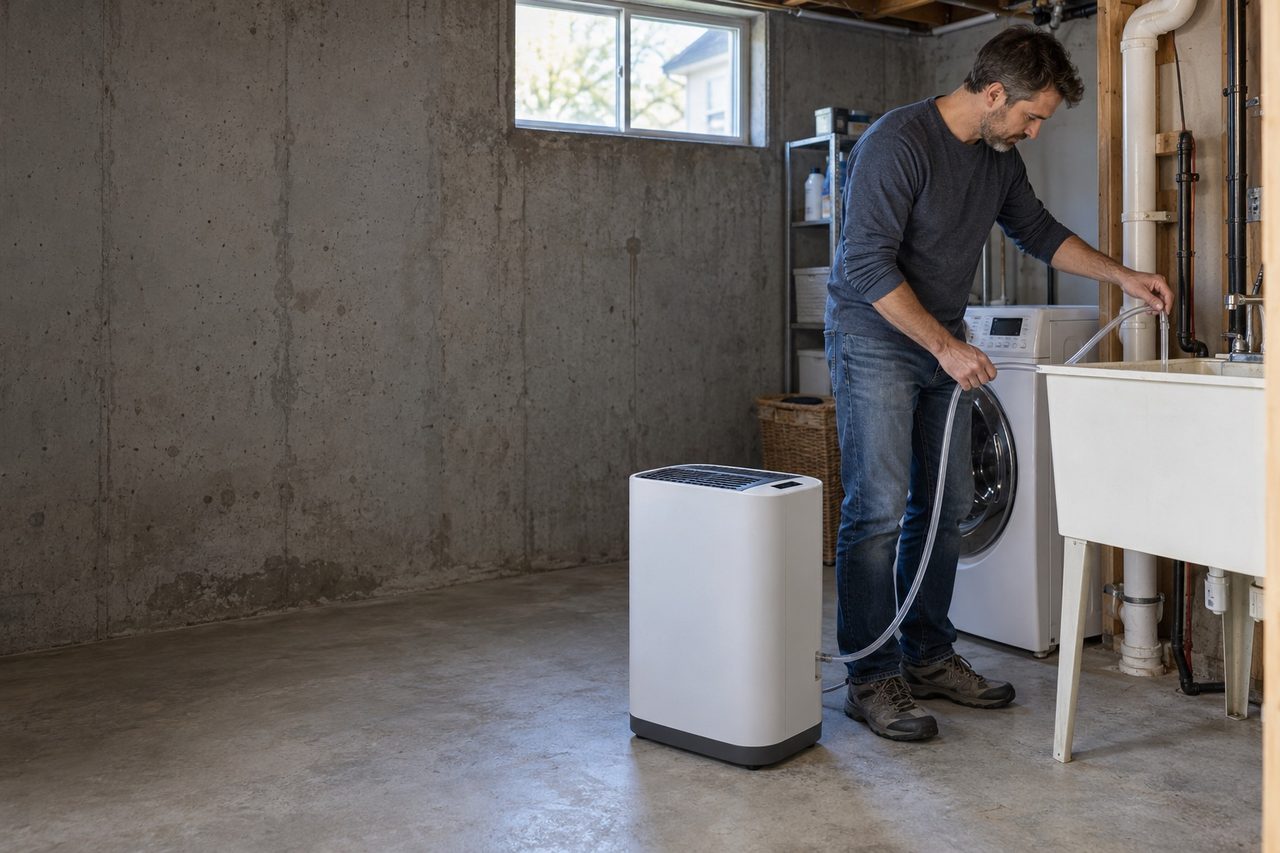
- Get the water out. Through the rim joist: drill a hole just big enough for the hose, seal around it, and end the hose outside where the ground slopes away from the foundation. Into a sump: clip the hose above the water line. Into a laundry standpipe: leave an air gap at the end.
- Plug into the GFCI outlet and keep the cord off the ground. Set the humidistat around 50 %.
- Watch the first full drain cycle: the pump should start, empty the reservoir and stop, with no drip at the fittings. Check again after the first rainy day.
- Leave your hygrometer in the far bay for two weeks and compare with your first readings.
The hose end outside is the detail that bites in January. A frozen hose backs water up into the unit, so keep the end short, sloping away and clear of mulch. The placement guide has more on clearances.
What a crawl space dehumidifier install really costs
The unit is most of the bill on a DIY job. Across the 28 crawl space units we rate with a recorded price, the range on Nov 17, 2026 ran from $309.59 (Airecoler 70-Pint Commercial) to $2,507.74 (AprilAire E100W Smart Wi-Fi), with a median of $504.83; prices may have changed since. The parts are small change by comparison.
| Item | Price range |
|---|---|
| Crawl space dehumidifier with built-in pump (16 priced) | $375.99 to $2,507.74, median $474.83 |
| Crawl space dehumidifier without pump (12 priced) | $309.59 to $2,368, median $579.86 |
| Separate condensate pump (3 priced) | $37.99 to $57.99 |
| 3/4" drain hose, 5 to 13 ft (9 priced) | $7.99 to $21.98 |
| Vapor barrier, seam tape, two pavers, hose clips, caulk | Hardware store, not in our catalog |
| Electricity | Watts on the nameplate × hours ÷ 1,000 × your rate |
Running cost is the number nobody prints. Few listings state the power draw, so read it on the nameplate and do the math: every 100 watts running around the clock is 2.4 kWh a day. A sealed crawl space is cheap to keep dry once it's dry; the humidistat stops the compressor at the set point, and the first weeks are the expensive part. Our energy efficient dehumidifiers list helps if power is the worry.
Hiring it out? Contractor prices swing with the region and, above all, with the prep. Ask for an itemized quote: the unit with its model number (compare it with the prices above), the drain line, any electrical work, the vapor barrier and the labor warranty. A "crawl space dehumidifier system" with no model number is the quote to question.
DIY or hire a pro?
Do it yourself when the crawl space is already sealed, an outlet is in reach, the drain route is simple and the unit fits through the hatch. That covers a lot of houses, and it's money better spent on a good unit than on labor.
- Call an electrician when there's no grounded GFCI outlet in the crawl space.
- Call a drainage or waterproofing contractor when water comes in, stands after storms or seeps through the walls.
- Call an HVAC pro when a furnace or water heater shares the space, or when you want the unit ducted.
- Call a remediation company when mold is already growing on the joists, not just a musty smell.
A middle path works well: buy the unit yourself and pay a pro only for the outlet or the barrier. Ask first, because not every installer fits a unit the customer supplies.
After the install: ten minutes a month
Look at your hygrometer, not just the unit's display. Rinse the filter as the manual says. Flush the pump reservoir and check the hose for sludge and kinks, because a slow drain is how pumps usually fail. The Aquastrong listing, for one, says its reservoir, float and filter basket need cleaning at least every six months. After a big storm, crawl in with a flashlight and check that the barrier is dry. 18 of the 32 crawl space listings mention auto-defrost; if yours doesn't and the space drops into the 40s °F in winter, read the cold-basement guide before you leave it running. The cleaning guide covers the rest.
Our rated picks
The three best-rated models of our best crawl space dehumidifiers with pump ranking, from the buyer review record and the listed specs.


Product images: Amazon listings
Frequently asked questions
How much does it cost to install a crawl space dehumidifier?
Doing it yourself, mostly the unit: $309.59 to $2,507.74 across the 28 crawl space units we rate, median $504.83 (Nov 17, 2026, prices may have changed). A hose adds $7.99 to $21.98, an add-on pump $37.99 to $57.99. A contractor's bill depends mostly on the prep.
Can I install a crawl space dehumidifier myself?
Yes, if the space is sealed, a GFCI outlet is in reach, the unit fits through the hatch and you have a drain route. Call a pro for missing electrical work, water coming in, or a furnace in the same space.
Where should a crawl space dehumidifier drain?
To a floor drain, a sump pit or outdoors. When the route climbs, use a built-in pump (16.4 to 19.6 ft of stated lift among the units we rate) or an add-on condensate pump.
Does a crawl space dehumidifier need its own outlet?
It needs a grounded outlet within cord reach, and US codes generally require GFCI protection in a crawl space. If there isn't one, have an electrician add it.
Should a crawl space dehumidifier sit on the ground or hang?
Either, if the manual allows it: on level pavers over the barrier, or from the joists; twelve of the units we rate mention a hanging kit or joist mounting.
What humidity should I set in a crawl space?
Around 50 %. The EPA recommends keeping indoor humidity below 60 %, ideally 30 to 50 %. Check it with your own hygrometer in the far corner.
References
Independent sources for facts stated in this guide, also linked where the guide states them.
- EPA: A Brief Guide to Mold, Moisture and Your Home · indoor humidity below 60 %, ideally 30 to 50 %; fix the water problem as well as the mold
- ENERGY STAR: dehumidifier buying guidance · capacity in pints per day, the sizing chart, drainage options and lower-temperature models below 65 °F
Products mentioned
- Waykar 125-Pint Crawl Space with Pump: pump and gravity hoses, lift (exact listing)
- Aquastrong Condensate Pump, 85 GPH: lift, flow, safety switch and cleaning interval (exact listing)