Updated November 13, 2026 · 5 dehumidifiers, no paid placements
Best Basement Dehumidifiers with Drain Hose in 2026
A floor drain a few steps away, and no wish to haul a full bucket up the stairs every evening? These five basement dehumidifiers come with a drain hose in the box and drain by gravity, so there's no pump to clog. Ranked on buyer ratings, review volume and the specs each listing states, hose length included.
The best-rated model for each hose length its listing states, among the 34 eligible listings. Measure from the spot where the unit will stand to the drain, then pick your row.
Find the drain first. Floor drain, sump pit or standpipe: note where it is and how far it sits from the spot the unit will live. That distance, not the size of the room, tells you whether the hose in the box is long enough.
Check that the route falls all the way. Gravity only works if the drain sits lower than the outlet and the hose never climbs on the way. If it has to go up, even a little, raise the unit on a sturdy, level base or pick a model with a pump.
Match the outlet before you buy a longer hose. Many listings say a standard garden hose fits; some name a smaller fitting. Look at the drain port in the manual of the exact model before you order the hose.
A hose in the box is not a drain plan
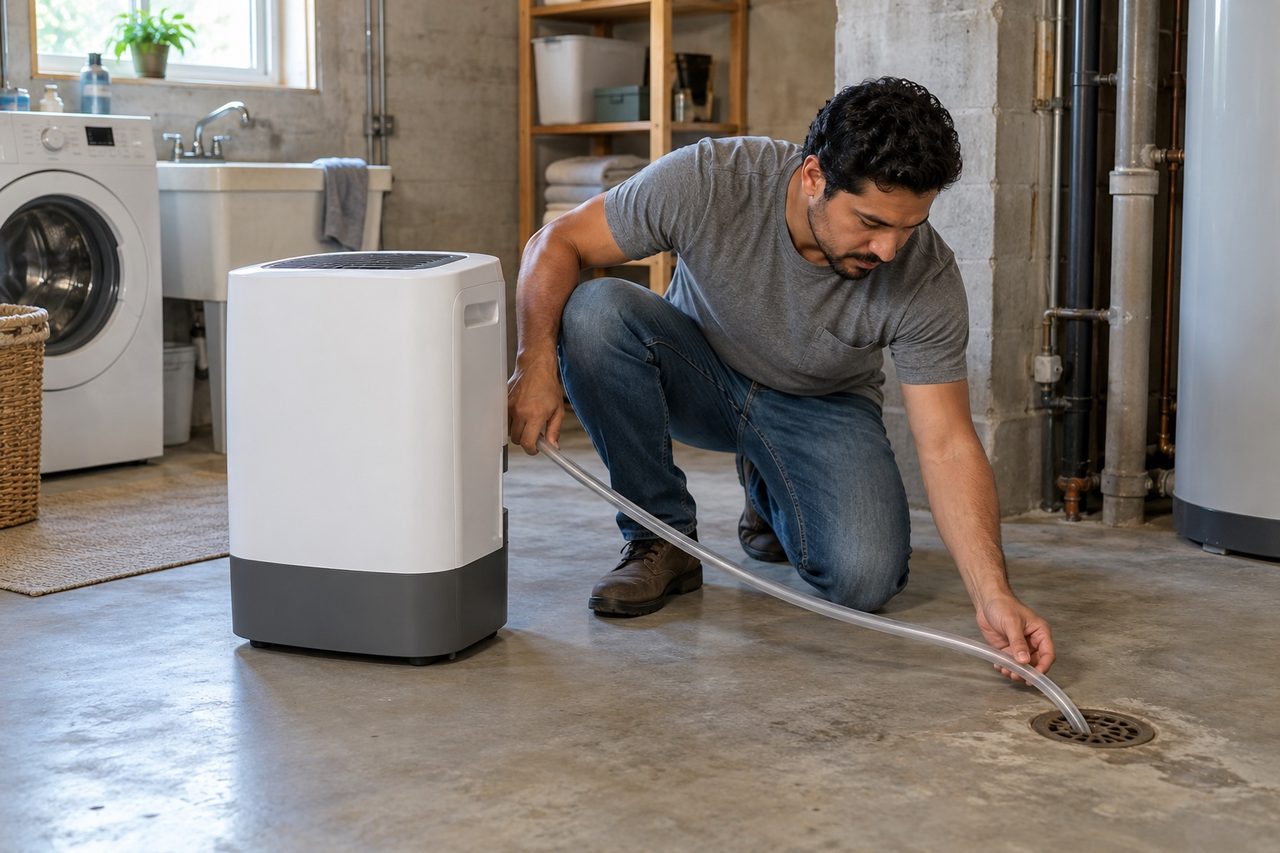
Almost every basement dehumidifier has a hose outlet. What the 34 eligible listings add is the hose itself, written into the listing, and no pump: the water leaves by gravity, so the hose has to fall from the outlet all the way to the drain. 21 of them state the length of that hose, from 23.6 inches to 6.56 feet, and the most common figure is about 3.3 feet (13 of 21), roughly 1 m. That's short. A hose of about three feet works when the unit sits right next to the floor drain or the sump pit, and not much farther.
This page sorts them for the hose question: what length comes in the box, whether a garden hose fits for a longer run, and how the water gets from the outlet to the drain. If your drain sits higher than the outlet, gravity can't help; the dehumidifiers with pump are the list for you.
Walk the route from the outlet to the drain
Do this before you buy, with a tape measure. Stand where the dehumidifier will live, find the drain outlet on the unit (usually low on the back or the side, the manual shows where), and follow the path the water will take: across the floor to the floor drain, the sump pit or a standpipe. Two things decide whether gravity works. The distance, which tells you if the hose in the box is long enough. And the height: the hose has to fall the whole way, so the drain must sit lower than the outlet, with no high point in between.
Here is the hose in the box, grouped by the length each eligible listing states. With the short ones, the unit stands next to the drain or you add a longer hose.
If some names look familiar from our basement dehumidifier ranking, that's no accident: four of its top five ship with a hose and qualify here too. The difference on this page is the question we sort for: the hose, the route and what it takes to make gravity do the work.
Need more reach? A garden hose usually fits
A hose of about three feet means the unit lives next to the drain. If the only good spot for it is across the room, you need a longer hose, and here the listings help. Twelve of the 34 eligible listings say a standard garden hose fits the outlet for a longer run; seven name the 3/4-inch thread, and one names a 1/2-inch fitting instead. The longer hose is usually not in the box, so add it to the cart with the unit.
Before you order, read the drain port section in the manual of the exact model: thread, washer, and whether the gravity outlet needs an adapter. Our drain hose size and fit guide walks through it, and the drain accessories ranking has hoses and fittings with the fit their listings state. A hose that kinks behind the unit is the classic way a gravity drain quietly stops working.
When the drain is higher than the outlet
Gravity has no workaround for this one. If the laundry sink, the standpipe or the window you have in mind sits above the drain outlet, the water won't go there by itself. You have two honest options. Raise the unit on a sturdy, level platform so the outlet ends up above the drain, keeping it stable and with the clearance the manual asks for (our placement guide covers it). Or pick a unit with a built-in pump that pushes the water up: those are in the dehumidifiers with pump ranking, and the gravity drain vs pump guide weighs the two.
A separate condensate pump placed under the outlet is a third way, if you already own a unit you like. It is one more part to buy, wire and clean, so for a new purchase we'd rather pick the right unit from the start.
Keep the water moving all year
A gravity hose has no motor to fail, which is why we like it. What it can do is kink, sag into a loop that holds water, or clog with the slime that grows in still water. Check it when you rinse the filter: the hose should fall in a straight line, without a dip, and the end should sit in the drain, not under the water level of a sump pit. Clean the outlet and the hose as the manual of your model describes.
In a cold basement, mind the coil before the hose. 20 of the 34 eligible listings mention auto-defrost, which matters when the basement sits below about 65 °F into spring; the cold-basement guide explains why. And if you ever run the hose outside, keep it out of the frost: a hose frozen solid in January backs the water up into the unit.
Comparison table
All 5 on one screen. Tap a column header to sort by what matters in your basement: pints, square feet, or where the water goes.
Comparison table: Best Basement Dehumidifiers with Drain Hose in 2026
† Prices as of Nov 17, 2026; they may have changed. The button always shows today's price.
How we rank
Every model gets a rating out of 10 from its exact listing: what buyers give it, how many of them there are, and how completely the seller documents the specs. The highest unrounded result wins; on an exact tie, the listing identifier decides.
Our editors also weigh how the models compare with each other, and that call is part of the score. A commission never moves a rating or a rank.
45 % buyer rating, damped when a listing has fewer than 50 reviews.
35 % review volume, on a logarithmic scale up to 5,000 reviews.
20 % documentation: feature bullets, images and stated brand of the listing.
Pints per day, coverage and drainage are shown only when the exact listing states them. They are the seller's figures, and test conditions vary from seller to seller.
Prices carry the date we recorded them. They may have changed since; the button shows today's offer.
Frequently asked questions
Which is the best basement dehumidifier with a drain hose in 2026?
Our pick is the Yaufey 120-Pint, 6,000 sq ft, at 9.6/10 (excellent). It has 6,463 buyer reviews averaging 4.5/5, and its listing states 120 pints/day and up to 6,000 sq ft. Close behind: the Kesnos 120-Pint, 6,500 sq ft at 9.5/10.
How is this ranking built?
We start from 34 basement dehumidifiers whose own listing states a drain hose in the box and a gravity drain, with no pump, each with a buyer review record. Each one gets a rating out of 10 built on the buyer rating (45 %), the number of reviews (35 %) and how completely the listing documents its specs (20 %), plus our editors' read of how the models compare. The highest score ranks first.
Do basement dehumidifiers come with a drain hose?
Many do, but don't take it for granted. Of the 53 basement dehumidifiers we rate with a gravity hose outlet and no pump, 40 state a hose in the box (the 34 of them with buyer reviews make up this ranking), and three say outright that the hose is not included; the rest only mention the outlet. Read the "in the box" part of the exact listing before you count on it.
How long is the drain hose on a basement dehumidifier?
Short. Among the eligible listings that state it (21 of 34), the hose in the box runs from 23.6 inches to 6.56 feet, and the most common figure is about 3.3 feet (13 of 21), roughly 1 m. Plan the spot for the unit around the drain, or get a longer hose that fits the outlet.
What size hose fits a basement dehumidifier?
It depends on the outlet. Seven of the eligible listings name a 3/4-inch garden hose fitting and one a 1/2-inch one; others don't say. Check the drain port in the manual of the exact model before you buy anything, and see our drain hose size and fit guide.
Can a dehumidifier drain hose run uphill?
No. With gravity the hose has to fall the whole way, from the outlet to the drain, without loops or a high point in the middle. If the drain is higher, raise the unit on a sturdy, level base or pick a dehumidifier with a built-in pump.
How much does a basement dehumidifier with a drain hose cost?
Among the 30 eligible listings with a recorded price: $110 (DR.PREPARE 38-Pint, 2,600 sq ft) to $1,780 (AprilAire E080 Pro Bundle), median $250, on Nov 17, 2026. Prices may have changed since; the button shows today's.
Can I use a longer hose than the one in the box?
Usually, yes. Twelve of the eligible listings say a standard garden hose fits the outlet for a longer run. Keep it falling all the way, avoid kinks, and leave the end where the water can drain freely.
Is a drain hose better than a built-in pump?
When there is a drain lower than the outlet, yes: a hose has no motor, makes no noise and costs next to nothing to replace. A pump earns its place only when the water has to climb or travel too far for a falling hose.
Are the prices up to date?
Each price is the one we recorded on Nov 17, 2026, and it may have changed since. The button always opens the exact listing with today's price and seller.
Ratings, ranks and specifications on this page come from each dehumidifier's exact listing and its buyer reviews, weighed by our published method; prices carry the date we recorded them. The references explain the terms used in this ranking; we link a manufacturer page only when it names the exact model.